Ukraine has turned drone warfare into an engineering feedback loop.
A crew flies a system until Russian electronic warfare finds a weakness. Operators report the failure. Engineers change the radio, navigation or software, then send a new batch back to the front.
I spent years building teams that shipped software several times a day. The mechanics feel familiar: release something small, inspect the result and fix what broke.
The consequences in Ukraine sit on another scale. A failed software release gives you an incident channel and a rough morning. A failed drone may expose its operator or leave a unit without observation.
The engineering impresses me. The reason it exists is bloody grim.
In May 2026, KettleTech Labs released footage of a fixed-wing Hornet drone hanging beneath a helium balloon. The balloon climbed to about 8,250 metres, released the aircraft and let it stabilise into a glide.
Reports claimed the Hornet finished with 95% battery charge and travelled 42 kilometres. That sounds amazing, until you compare the reports.
Defence Blog says the balloon carried the Hornet 42 kilometres before release. Defense Express says the drone landed 42 kilometres from its launch point after gliding.
Those descriptions cover different parts of the flight.
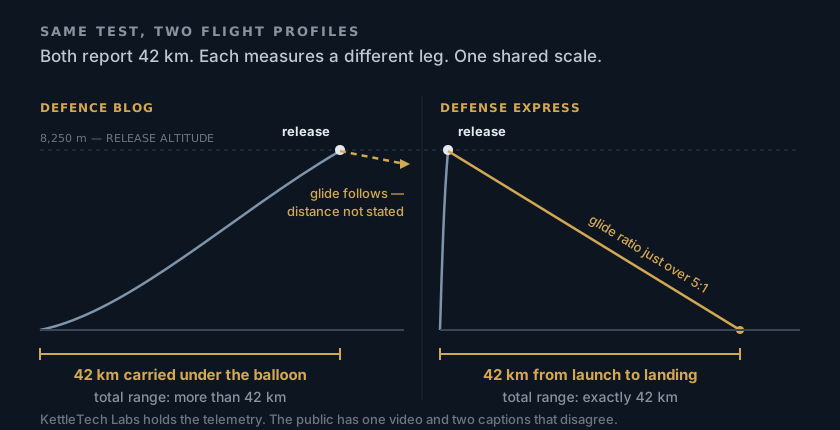
A 42 kilometre glide from 8.25 kilometres up would require a glide ratio a little above 5:1. A fixed-wing aircraft can manage that. Wind, release position and the missing telemetry still matter.
The same reports put the Hornet’s normal range between 150 and 200 kilometres, then estimate a balloon-assisted range between 190 and 300 kilometres. The manufacturer has not published those numbers.
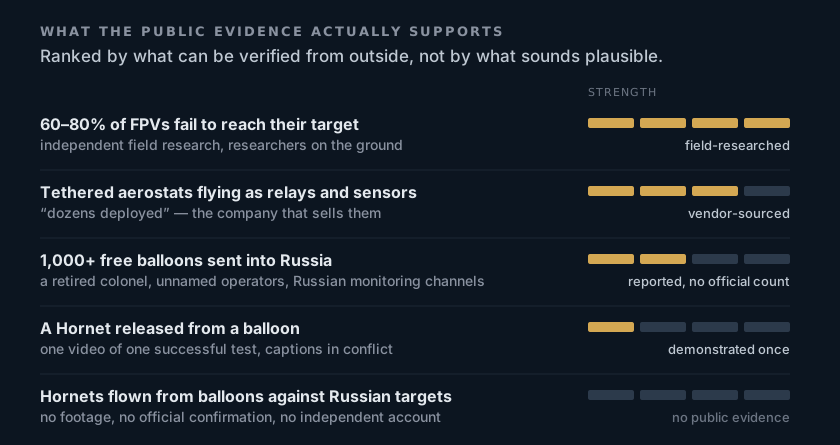
The footage supports one successful release test. It does not prove that Ukrainian crews have launched Hornets from free balloons over Russian targets.
Three balloon systems
News reports keep using “balloon”, “aerostat” and “drone carrier” for three different systems.
Ukraine has used tethered aerostats as radio relays and sensor platforms for years. A cable holds the balloon above friendly territory while supplying power to the equipment underneath it.
Aerobavovna CEO Iurii Vysoven told IEEE Spectrum that his company had deployed dozens of these systems by April 2025. He said a radio repeater raised 500 metres could cover a radius of around 80 kilometres. That figure comes from the company, though the benefit follows basic radio geometry: lifting an antenna extends its line of sight.
These aerostats let crews place the ground station farther from the front. They can also carry cameras and radio-direction equipment.
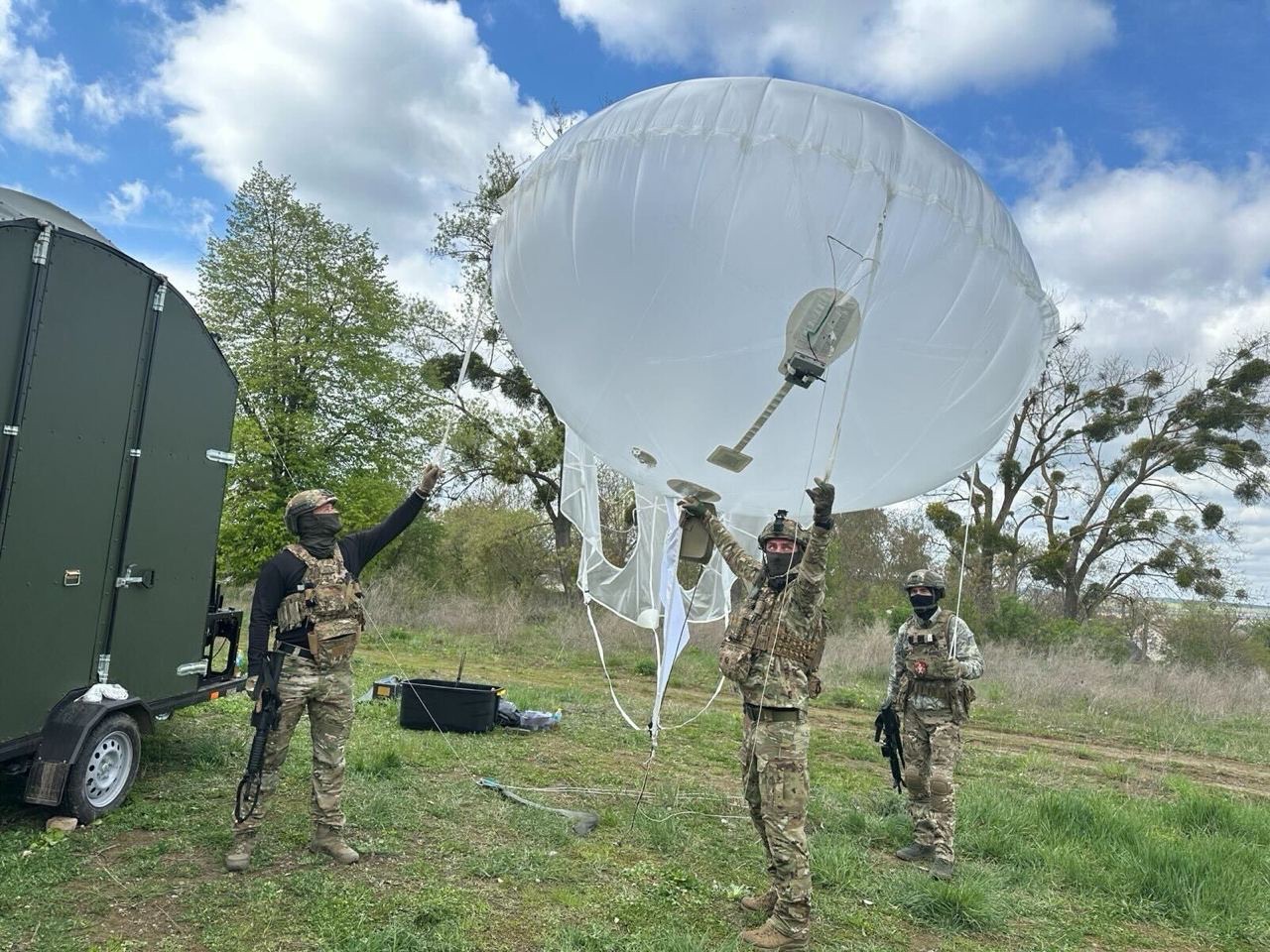

A second design turns the tethered aerostat into an interceptor tower. Photos published in March 2025 showed a thermal camera and a fixed-wing interceptor mounted under an Aerobavovna balloon. Militarnyi reported that an operator could release the interceptor after the camera detected an incoming Shahed.
Vysoven told IEEE that engineers had only started those trials. Public photos proved that the prototype existed. They did not prove a working air-defence network.
The third system cuts the tether and lets the wind carry the balloon east. It may carry a decoy, radio relay or another aircraft.
Euromaidan Press reported that Ukrainian forces had sent more than 1,000 free balloons into Russia. A retired Ukrainian colonel supported the account, alongside operators who withheld their names. Russian monitoring channels also reported balloons during a large drone raid in September 2025.
Ukraine has not published an official count. I would treat the 1,000 figure as a credible report rather than a confirmed total.
A fourth idea sits in development. In June 2026, a Ukrainian company presented DART, a small balloon-launched rocket designed to continue on a fixed course after switching off its navigation receiver. The company said that would deny radio jammers a signal to corrupt during the last part of flight.
Militarnyi published developer renders and specifications. The developer also said DART still needed Ukrainian military codification. It belongs in the prototype column for now.
Jamming reaches into the whole stack
The airframe gets most of the photos. The communications and navigation stack decides whether it reaches useful airspace.
An FPV pilot needs a low-latency command link and a video feed. A fixed-wing strike drone may combine satellite navigation with inertial sensors, terrain matching or visual odometry. An onboard computer can track the selected object once the radio link drops.
Russian electronic warfare attacks the command link, video return and satellite navigation. Russian units also use radio emissions to locate drone crews. Ukrainian jammers can disrupt friendly aircraft if units fail to coordinate their spectrum use.
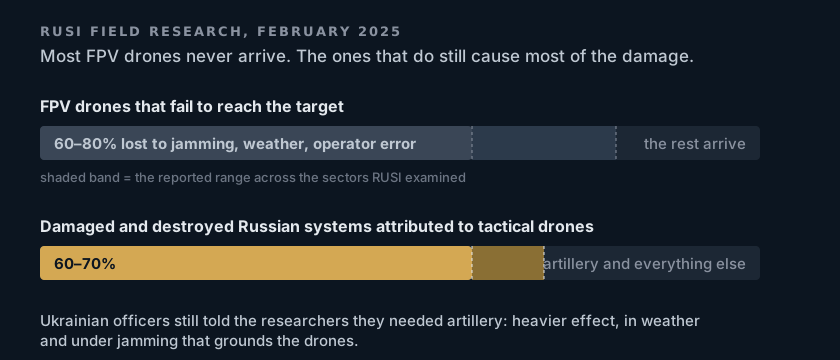
RUSI’s February 2025 field research found that 60–80% of Ukrainian FPV drones failed to reach their targets in the sectors its researchers examined. Operator skill, weather and electronic warfare changed the rate.
The same report estimated that tactical drones caused 60–70% of damaged and destroyed Russian systems. Ukrainian officers still told the researchers that they needed artillery. Drones could find or immobilise a vehicle, while artillery delivered a heavier effect in poor weather and under dense jamming.
Fibre-optic FPVs solve the radio-link problem with a physical strand of glass that unwinds behind the aircraft. A jammer cannot corrupt commands or video travelling through that cable.
The cable brings its own problems. A Swedish Defence Research Agency study found that the spool adds weight, reduces endurance and can snag on terrain. The fibre carries data rather than electrical power, so the drone still depends on its battery.
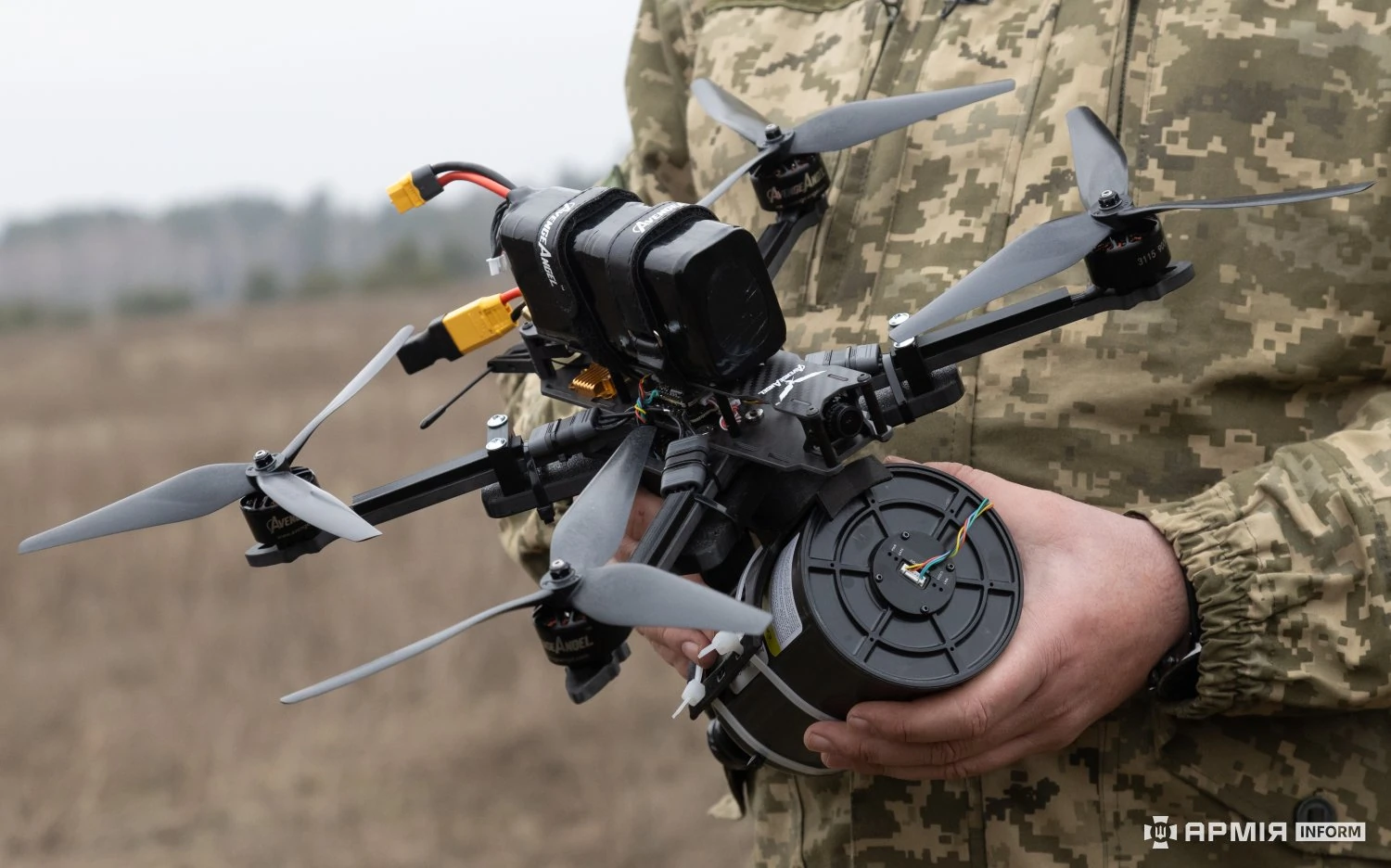

Engineers have also pushed more work onto the aircraft.
Reuters reported in October 2024 that Ukraine had deployed dozens of domestic automation systems. NORDA Dynamics said it had sold more than 15,000 copies of software that lets a pilot select an object through the camera, then hands the final approach to computer vision.
Call that terminal guidance. A human chooses the target before the software tracks it.
Ukraine’s Defence Ministry described a more advanced interceptor in June 2026. The ministry said the system automates 95% of an interception cycle. An operator watches the air picture, selects a target and authorises engagement. The interceptor handles guidance, identification and tracking after that command.
“AI drone” covers a huge range of capability, from keeping a truck centred in the camera to coordinating several aircraft. Treating all of it as autonomous target selection makes the technology sound more mature than the evidence supports.
The battlefield plugs into the factory
Ukraine connects these aircraft to a wider software system.
NATO describes DELTA as a cloud-based integration platform and national data lake. It combines reports from drones, radars, satellites and ground units into a shared battlefield view.
Ukraine added Vezha for drone-video streaming and Mission Control for flight planning. Mission Control also helps units avoid sending several FPVs through the same patch of spectrum.
The result looks less like a fleet of remote-control aircraft and more like a distributed application. Sensors create tracks. Commanders assign work. Drone crews execute missions, then report what happened.
Ukraine has wired those results into procurement.
A 2025 CSIS study based on more than 50 interviews describes a commercial-first system. Private companies fund working prototypes. Military units test them, buy useful models and send feedback to engineers without waiting for a multiyear programme.
By January 2026, Brave1 Market gave participating manufacturers a dashboard showing confirmed hits, target types, operating distance and product rankings. ArmyInform documented the dashboard and the data available to suppliers.
In June, Ukraine’s Defence Ministry said military units had ordered more than 500,000 drones through Brave1 Market. Ordered does not mean produced or delivered, though it shows the scale of the purchasing system.
I started my engineering career in support at Vend. The person sitting closest to the failure often had the best product signal. You lose that signal when it passes through five teams and a quarterly planning process.
Ukraine has shortened that route from operator to engineer.
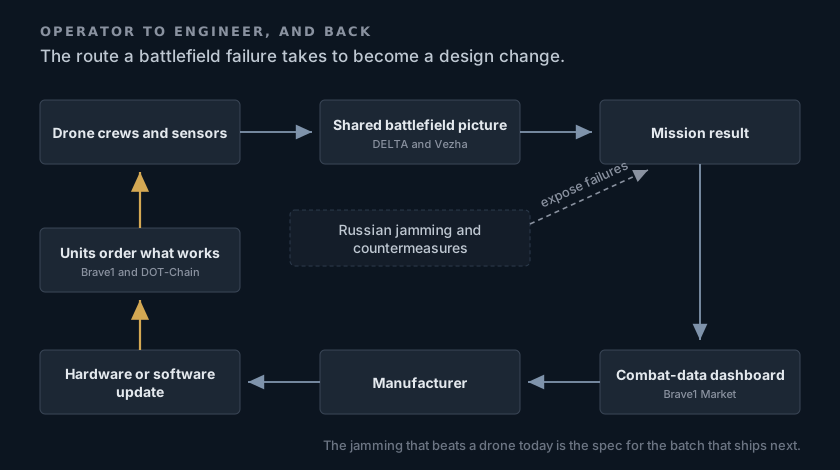
Speed creates mess as well.
Another CSIS study found more than 550 unmanned systems on one government-supported marketplace. Units gained choice, while maintainers inherited incompatible parts, firmware and training requirements.
Central procurement can take months and distort feedback before engineers receive it. Unit-level purchasing moves faster, though it weakens standardisation and long-term planning. Ukraine now uses digital marketplaces and combat data to keep the speed while reducing some of that fragmentation.
The metrics need scrutiny too. A confirmed strike makes a clean dashboard event. A drone lost to jamming may produce little data. Units can favour targets that generate more purchasing points. Manufacturers will optimise around whatever the system measures.
The balloon test fits this engineering culture. It combines cheap lift, an existing fixed-wing drone, automatic release and onboard stabilisation. Engineers can test each part without waiting for a new aircraft programme.
Wind still controls the free balloon’s route. Weather can cancel a launch window. The drone needs navigation and, in many missions, a communications path after release. A balloon can save battery and add altitude, though it cannot remove those constraints.
The Hornet footage leaves one basic detail unresolved: did the balloon drift 42 kilometres before release, or did the drone glide that distance afterwards?
The outlets disagree. KettleTech Labs has the telemetry. The public has a video, several contradictory captions and no confirmed combat release. For now, that is where the evidence stops.