New Zealand knows how many days of diesel it has.
At 11:59pm on Sunday 23 August, the answer was 44.8 days in the country or on ships headed here. Petrol was 49.2 days. Jet fuel was 42.
A separate Crown-controlled diesel reserve at Marsden Point sat outside those numbers. MBIE publishes the count every Wednesday.
We do not know how many days of AI New Zealand has.
Days may be the wrong unit. You can put diesel in a tank. You cannot put next month's inference in a tank. A token is made at the moment somebody asks for it, using a model, a rack of accelerators, electricity, cooling, storage, networks and people.
That makes the more useful question harder.
If foreign AI suppliers stopped taking our orders, how much useful inference could New Zealand produce for itself?
At the moment, not enough of the answer is under our control.
A modest version of this argument says we should keep some open-weight models, make systems portable and sign backup contracts. We should do all of that. It is no longer enough.
New Zealand should build nationally controlled data centres and the power infrastructure behind them. We should negotiate the right to run allied models on those machines. We should keep using the best global services in normal times, but own a strategic layer that nobody overseas can switch off for us.
We do not need to build a frontier model yet. We need to secure the means of inference.
Forty-four point eight days
New Zealand's minimum stockholding rules took effect in January 2025. Fuel importers must hold an average of 28 days of petrol, 24 days of jet fuel and 21 days of diesel, either in eligible tanks here or aboard ships inside our Exclusive Economic Zone.
Those are not literal countdown clocks. The obligation applies to individual importers over a month, using historical demand. Distribution matters. Demand can be reduced. A ship inside the EEZ counts even though the fuel is not yet in a terminal. The public totals also include ships outside the EEZ that may still be three weeks away.
The numbers are still useful. They tell the Government what exists, where it is and how much time it might have if the next shipment does not arrive.
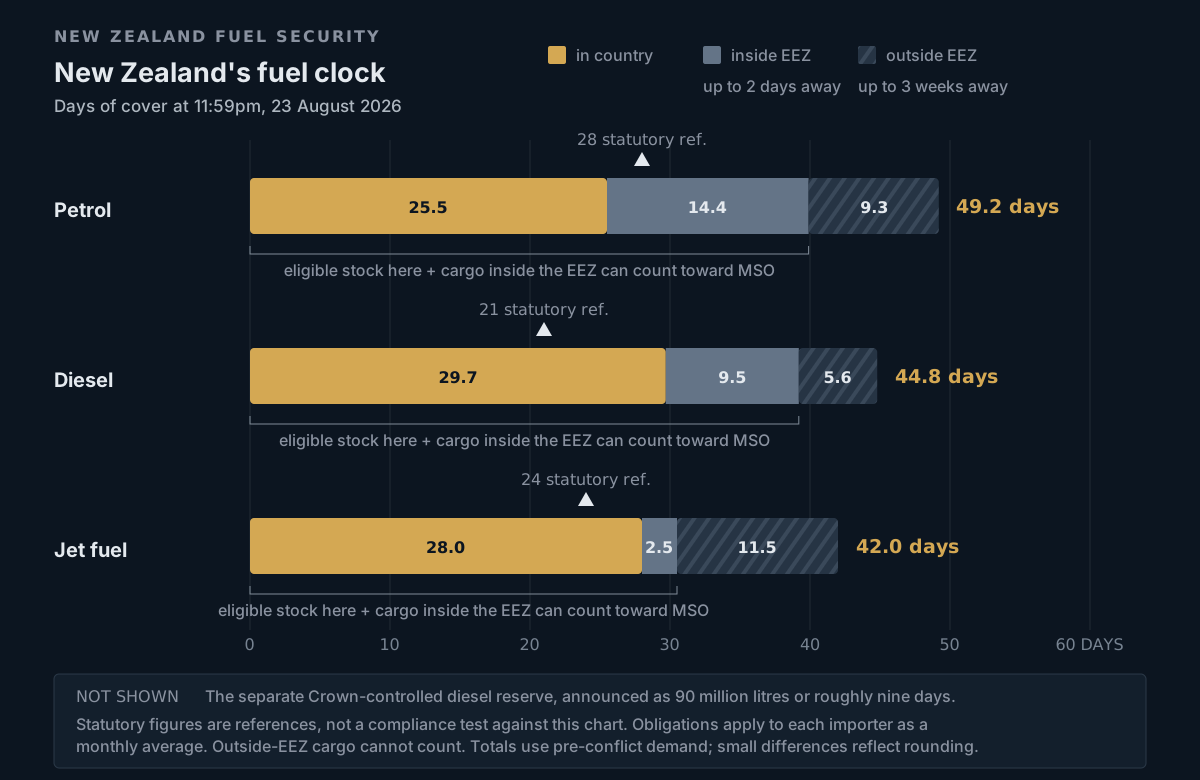
The rules got a live test fourteen months after they began. The United States and Israel launched strikes on Iran on 28 February 2026, and Iran retaliated across the region. Tanker traffic through the Strait of Hormuz fell to a near standstill. By August, the International Energy Agency was still describing the passage as effectively closed.
This was not a distant problem for an island at the bottom of the Pacific. Marsden Point stopped refining crude in 2022, so New Zealand now imports all of its petrol, diesel and jet fuel as finished products. In 2025, 51% came from South Korea, 31% from Singapore, 9% from Malaysia and 3% from Japan.
We do not buy all of that fuel directly from the Gulf. We buy from Asian refineries that buy crude in a global market shaped by the Gulf. One step removed is not independent.
The pumps did not run dry. New Zealand remains in Phase 1 of the Fuel Response Plan, with supply arriving normally and no purchase restrictions.
Prices carried the shock instead. In the Commerce Commission's national-average retail series, regular 91 rose from $2.57 a litre on 28 February to a peak of $3.50 on 8 April. Diesel rose from $1.88 to $3.89 by 13 April, slightly more than doubling.
The Government used the time in the buffer to create more options. It temporarily accepted Australian fuel specifications so importers could buy from more refineries. It contracted Z Energy to manage 90 million litres of strategic diesel at Marsden Point, roughly nine days of normal consumption, with the Crown controlling its release. In July, an essential supplies agreement with Singapore came into force.
The buffer was never going to make New Zealand energy independent. Its job was to buy time while the Government added options around the supply chain.
That is the useful part of the analogy.
A token is not a barrel
People keep calling AI the new oil. I understand why.
Both have concentrated choke points. Advanced chips are fabricated in a small number of places. The latest accelerators are designed by a small number of companies. Frontier models are controlled by an even smaller group. Access can be rationed by price, contract, export controls or geopolitics.
The metaphor breaks at the important bit. Oil can be stored. Tokens cannot. They are not even a standard commodity. A million tokens from one model are not equivalent to a million from another, and a cheap answer that is wrong is not a strategic reserve.
Compute is closer to the refinery. Inference is the utility it produces.
Electricity goes in. Useful machine work comes out. The quality and quantity depend on the chips, model, software and skills available at that moment.
The national asset is therefore not a model file. It is a working conversion system that New Zealand can allocate when other suppliers become unreliable.
That distinction matters because dependency is arriving quietly. In the 2026 cross-agency survey, 59 public organisations reported 545 AI use cases, up from 272 the year before. Of those, 167 were operational, three times the 2025 count. Most helped staff and back-office functions, but more than half directly or indirectly supported public-facing services.
New Zealand does not stop functioning if frontier-model APIs go offline today. Claims that AI is already critical national infrastructure run ahead of the evidence.
The direction is still clear. The Public Service AI Work Programme includes shared tools, strategic supplier agreements, an AI marketplace and a public-facing assistant for Govt.nz. Businesses are building the same dependency into software delivery, document processing, customer support, fraud detection and research.
Dependency arrives one useful workflow at a time. Nobody holds a ceremony when the manual fallback quietly stops being maintained.
A cloud region is not a reserve
New Zealand has made real progress on local cloud infrastructure.
Microsoft opened its three-zone New Zealand North region in December 2024. AWS opened three availability zones here in September 2025. That improves latency, resilience and data residency. It is good infrastructure and we should want more of it.
It is not the same as sovereign compute.
When Amazon Bedrock launched at the New Zealand endpoint in March 2026, AWS said the initial Anthropic and Amazon models were available using cross-region inference. The front door was in New Zealand. The model execution did not have to be.
Even when the hardware is physically here, the owner, control plane, operating keys, model licence and parent jurisdiction can remain somewhere else. Data residency answers where the data is meant to sit. Sovereignty asks who can keep the service running, change it, inspect it and allocate it during a crisis.
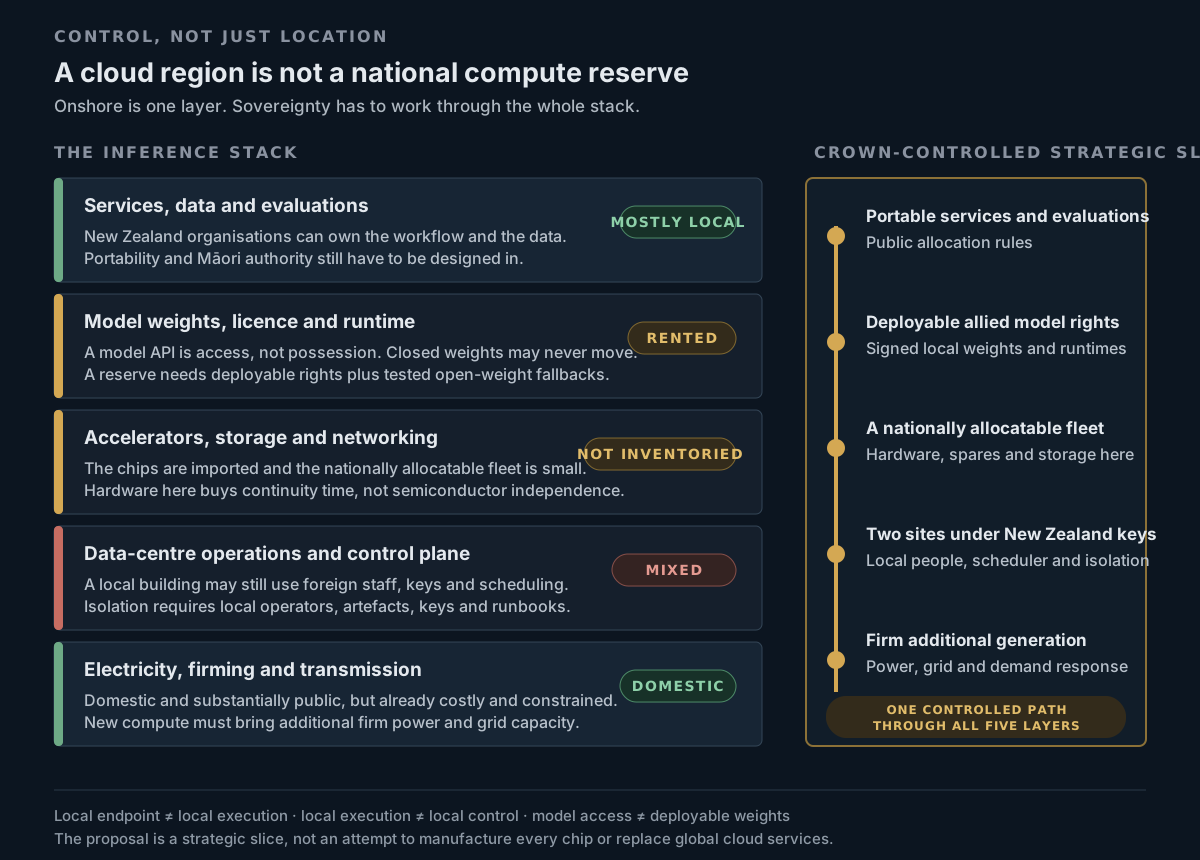
New Zealand is not starting from zero. NeSI's standalone MBIE investment concluded on 30 June 2025, but its staff, assets and services were folded into the Crown-owned REANNZ the next day. The resulting eResearch Infrastructure Platform has $69.65 million of government funding contracted through June 2030. It combines REANNZ's network with the former NeSI high-performance computing services. Earth Sciences New Zealand has a fourth-generation supercomputer, and local providers such as Catalyst and Datacom offer New Zealand-operated GPU and sovereign-cloud services.
Those are foundations to build on. They are not yet a published national reserve for public services and the wider economy. The two-site reserve I propose below does not exist today. REANNZ's August 2026 hardware inventory, for example, lists 48 GPUs across four types. That is valuable research infrastructure. It is not a frontier-scale fleet.
REANNZ has explored something larger. In November 2025 it issued a request for information for a national AI infrastructure platform. But its June 2026 performance plan still said it would work with officials to secure funding for AI infrastructure at scale. That project was still an ambition, not a reserve New Zealand could count on.
Nor do we have a public inventory showing how many accelerators exist across the country, which workloads they can run, who controls their schedulers or what remains usable if international networks and vendor control planes are unavailable.
We have data-centre geography. We have not yet demonstrated sovereign frontier inference.
Power is the reserve
The first limit on domestic compute is not ambition. It is electricity.
New Zealand's power system set a new demand record of 7,415 MW on 6 August 2026. The system stayed up, but low wind and cold weather made it tight enough for large industrial users to reduce demand.
The price story is less comfortable. Across households and small businesses, power prices rose by an average 8% in 2025 and another 6.8% in the first half of 2026. Higher lines charges caused 54% of the latest increase and are expected to keep rising through 2030 as the country replaces old assets and expands the grid.
Generation became more expensive too. The average monthly wholesale price at the important Ōtāhuhu node was about $100 per MWh from 1997 to 2018. From 2019 to early 2026 it averaged $160 per MWh, with declining domestic gas supply a major cause.
There is plenty to like in the underlying system. In 2025, New Zealand generated 44,140 GWh of electricity and 88.5% came from renewable sources. New geothermal, wind, solar, hydro upgrades and batteries are arriving. The problem is making enough firm power available at the right place and time, including cold, dry, windless periods.
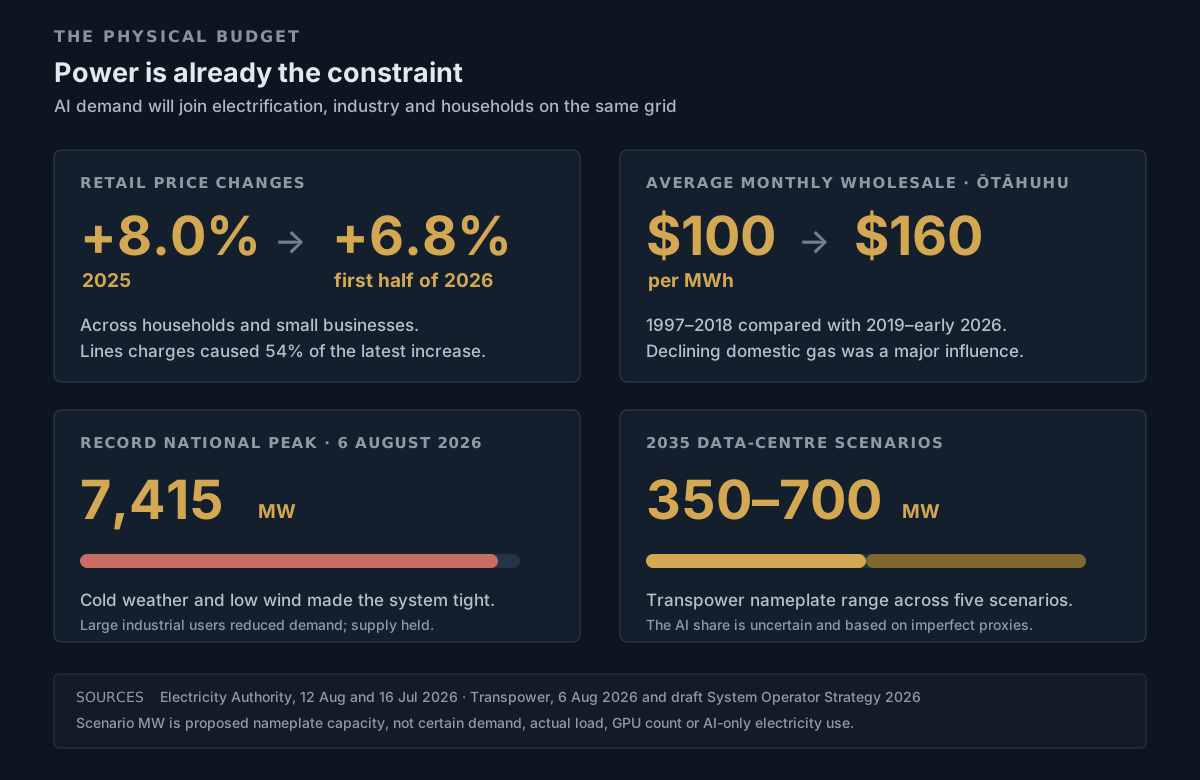
AI makes that physical constraint harder to ignore. Transpower's draft 2026 System Operator Strategy puts 2035 data-centre nameplate demand between 350 MW and 700 MW across five scenarios. Transpower is careful to say estimates of AI's share rely on imperfect proxies. These are scenarios, not a forecast.
Even the low end is material on a grid whose record peak is 7.4 GW.
Cheap and reliable energy is not a magic GDP dial. Economies can become more energy efficient, and electricity alone does not create productive companies. But energy is enabling infrastructure. When it becomes expensive or scarce, it constrains investment and output.
Modelling commissioned by MBIE estimated that higher electricity and gas prices since 2017 left New Zealand's real GDP in 2025 about 1.25%, or $5.2 billion, below a lower-price counterfactual. That is a modelled scenario, not an observed one-for-one law. It is still a large estimate of the cost of getting this input wrong.
For AI, the connection is unusually direct. Electricity and chips are converted into an input used to write software, discover materials, analyse data and run services. A country with abundant, firm power can make more of that input. A country without it rents the output from somewhere else.
This creates a hard rule for any national compute programme: every megawatt of new strategic compute should arrive with genuinely additional generation, firming and grid capacity.
Renewable certificates are not enough. A data centre that claims an annual wind offset while drawing scarce power on a cold, still morning has not solved the system problem. Large compute loads should pay their full connection and transmission costs, be interruptible outside protected workloads, and underwrite the new generation and storage needed to serve them.
Otherwise sovereign AI becomes a scheme in which households and existing industry subsidise somebody else's server racks.
Nationalise the strategic layer
By nationalise, I do not mean seize every AWS rack or put the whole electricity market inside a ministry.
New Zealand already owns useful levers. Transpower is a state-owned enterprise. The Crown retains controlling stakes in Genesis, Mercury and Meridian. Many lines companies are owned by councils or community trusts. The ownership mix is already partly public. We should use that public balance sheet and control deliberately.
I would create a Crown-controlled compute utility.
It should own the strategic assets: land, substations, accelerator hardware, operating keys, the capacity scheduler and the contracts that determine who gets access. Private companies can design, build and operate parts of it. Universities, local cloud providers, iwi investment entities and New Zealand institutional capital should participate. The Crown should retain majority control or a golden share over the emergency capability.
Start with a modular 2 to 5 MW accelerator reserve spread across two physically separated sites. Depending on the hardware and design, that is roughly hundreds to a low thousand modern accelerators. It is not enough to train the next frontier model. It is enough to run useful national inference, adapt open models, evaluate new releases, support research and keep selected services alive.
Build the sites, substations and generation contracts with an owned path to expand. Capacity should grow when audited demand justifies it, not when a minister needs a large number for a press release.
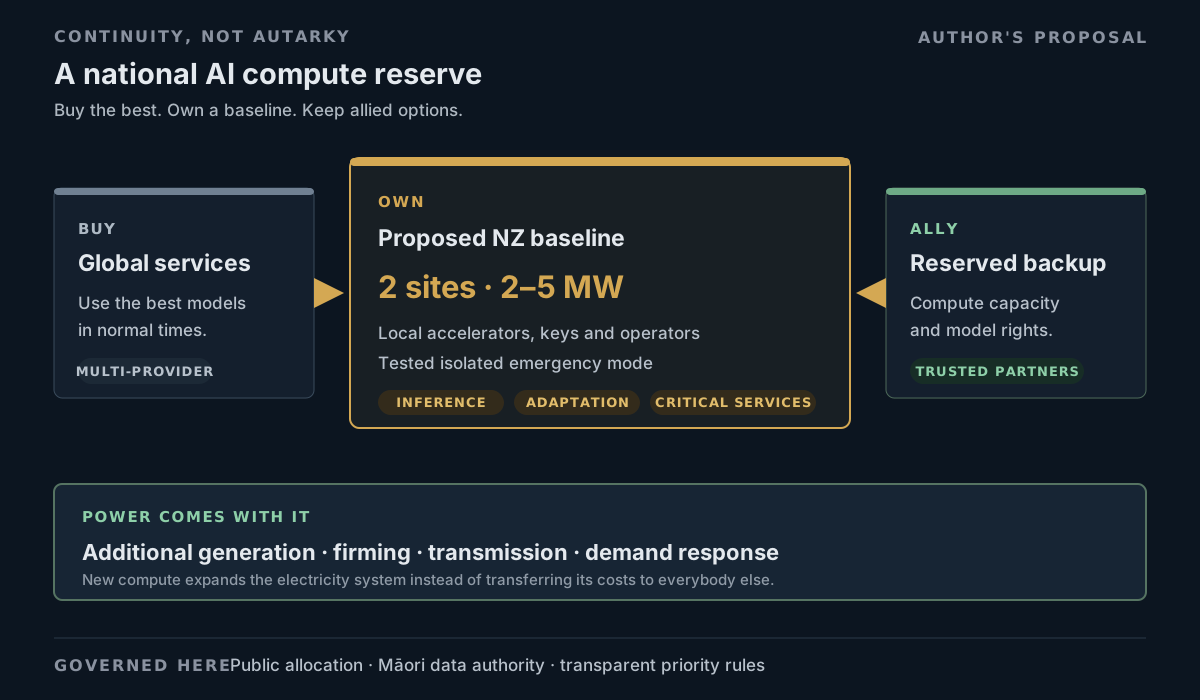
The utility would serve three markets in normal times. Researchers and public interest projects receive allocated access. New Zealand startups and smaller firms buy subsidised capacity where a lack of compute blocks growth. Commercial users pay market rates and help keep the fleet current. A protected slice stays available for continuity testing and emergencies.
This is not an invented category. Canada has committed up to C$2 billion to domestic commercial capacity, public supercomputing and a compute access fund. The United Kingdom's public AI Research Resource includes 5,448 Nvidia GH200 superchips at Isambard-AI and 1,024 Intel GPUs at Dawn.
New Zealand is smaller. That is an argument for selecting the useful layer, not for owning none of it.
The model strategy should be allied and plural.
For open-weight models, keep signed copies of the weights, licences, runtimes, software bills of materials and evaluations here. Test them on the reserve every month. An untested fallback discovered during the outage is not a fallback.
For closed frontier systems, do not pretend an API contract gives us the weights. It usually will not. Negotiate reserved capacity, local-processing evidence, exit clauses, portable prompts and logs, customer-held keys and tested failover. Where a supplier will licence a model for on-premises deployment, make that part of a government or allied procurement deal.
Then build reciprocal compute agreements with Australia, Canada, the United Kingdom and Singapore. The aim is not autarky. It is enough local control and enough allied alternatives that one foreign company's decision does not become New Zealand's outage.
Nuclear-free does not have to mean reactor-free
If compute becomes an economic input on the scale I expect, generation becomes technology policy.
New Zealand should build more geothermal, wind, solar, hydro upgrades, batteries and transmission now. These are available, increasingly economic and can add capacity this decade.
We should also make civilian nuclear generation a real option.
That does not require abandoning New Zealand's opposition to nuclear weapons. The Nuclear Free Zone, Disarmament, and Arms Control Act 1987 bans nuclear explosive devices and visits by nuclear-powered ships. It does not expressly ban a stationary civilian power station. In May 2026, New Zealand itself told the Nuclear Non-Proliferation Treaty review conference that while we do not use nuclear energy, we recognise states' right to do so under proper safety, security and waste standards.
The legal misunderstanding is the easy part.
New Zealand does not have a modern reactor regulator, an experienced nuclear workforce, a civil-liability regime or a pathway for spent fuel and decommissioning. The International Atomic Energy Agency's milestones approach lists 19 separate infrastructure issues a new nuclear country must resolve. Building that capability takes longer than building the plant.
The economics are not ready either. New Zealand's grid makes a conventional gigawatt-scale reactor awkward. One unit would equal roughly 13% of our latest record peak, a very large single failure for the system to cover.
Small modular reactors fit our scale better. They are also still an emerging commercial product. The IEA expects the first commercial SMR projects around 2030. Australia's 2025–26 GenCost work estimates 2030 SMR electricity at A$336 toA$546 per MWh, far above its estimates for wind and solar. Those are Australian modelling assumptions, not New Zealand bids, but a small first-time market is unlikely to begin with a cost advantage.
So no, a reactor will not lower next winter's power bill or keep an API online next year.
That is not an argument for refusing to prepare. It is an argument for starting before we need one.
I would commission a 12 to 18 month civilian nuclear-readiness programme now. It should compare small reactors with geothermal, storage, transmission and other firm generation on total system cost. It should map plausible sites, seismic and cooling constraints, grid integration, regulation, fuel, waste, insurance, workforce and emergency planning. It should include iwi and host communities before a site appears on a map, not after a deal is announced.
Deployment should have hard gates: a reference reactor operating in a comparable OECD market, an all-in price that can beat New Zealand's firm alternatives, an independent regulator, a funded waste plan and durable host consent.
I think we should prepare to build if those tests are met.
Keeping nuclear weapons out of New Zealand is a moral and strategic position. Refusing to examine civilian reactors is not the same thing. It is simply choosing to have one fewer option in an electricity-constrained future.
Whose sovereignty?
Public ownership solves only part of this.
Fuel does not have a language, a history or an opinion about who owns knowledge. Models do.
Manatū Taonga's 2025 Long-term Insights Briefing warns that global models can misappropriate Māori cultural intellectual property, flatten differences between iwi and hapū, and present one answer as correct where several traditions exist.
A model running on Crown-owned GPUs does not solve that. Feeding Māori language, history and knowledge into a national system without Māori authority over how it is used would reproduce the extraction with a New Zealand data centre attached.
The compute utility therefore needs Māori governance over Māori data, knowledge and language, not a consultation workstream added after procurement. The same applies to the land, water and generation used by its data centres.
It also needs public allocation rules. In a constrained period, who gets the machines? Emergency management? Hospitals? The electricity system itself? Science? Export firms? The answer should be decided before the queue forms and published wherever national security allows.
National control without legitimate governance is only a different owner.
The ability to make inference
New Zealand does not need its own OpenAI yet.
It needs a national compute inventory, two controlled sites, additional power, tested open-weight models, allied deployment rights, portable systems and people who rehearse the switch. It needs to know what runs on day one, day seven and day thirty when the normal suppliers are not available.
The fuel reserve buys time because somebody counted the tanks, wrote the rules and kept a physical option under Crown control.
An AI reserve will not be a warehouse full of tokens. It will be a factory we can turn on.
A country that cannot turn its own electricity into trusted inference is renting part of its future productive capacity by the token.